
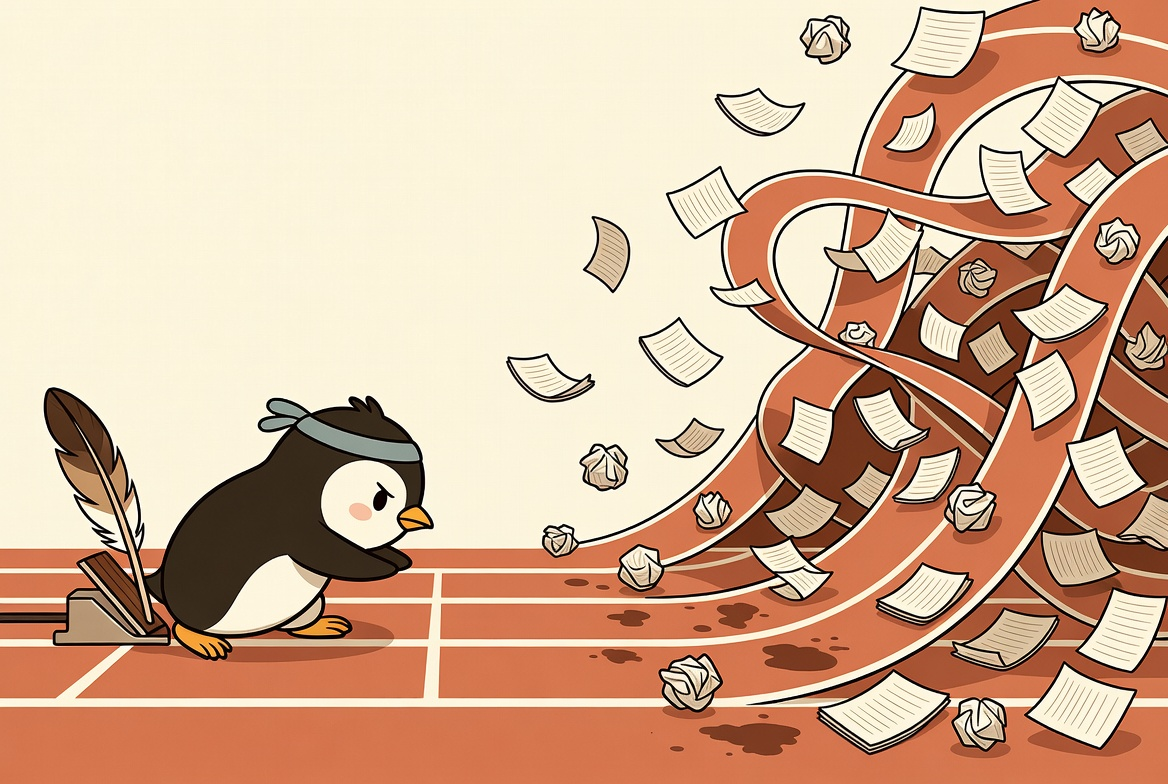
The best story starters are sentences you didn’t have to write. The cursor is already past the worst part. Someone hands you sentence one, and now your only job is sentence two, which is the place where writing actually starts. That’s the point of every starter on this page.
You’re going to find more than thirty-five of them below, sorted into six clusters so you can skip whatever doesn’t grab you and steal whatever does. They are deliberately weird. A casserole arrives with a note. A talking houseplant has been keeping a journal. Your boss schedules a 4 p.m. meeting titled “the situation.” That is on purpose. Weird starters bypass the part of your brain that wants to write something good and drop you straight into the part that just wants to find out what happens next.
Pick one. Set a timer for twelve minutes. See where it spirals.
Why One-Sentence Starters Work (When Most Prompts Don’t)
A one-sentence starter beats a generic prompt because it removes the only sentence that’s harder than every other sentence: the first one. Most writing prompts dump a topic in your lap (“write about loneliness”). A starter dumps you mid-scene with the work of beginning already done.
There are three reasons the good ones launch a story while the bad ones stall. First, specificity. “A casserole arrived in the mail” launches a story. “It was a strange day” doesn’t, because nothing has happened yet. Established craft writing has been saying this for decades, from Janet Burroway’s Writing Fiction to Anne Lamott’s permission-to-be-terrible argument in Bird by Bird. Concrete nouns in the opening clause give your brain something to chase.
Second, the good starters have conflict already built in. Something is wrong, weird, or about to be. The reader’s next move isn’t “what should I write about?” It’s “what happens next?” That’s a much shorter mental trip.
Third, room to escalate. A starter is a doorway, not a hallway. It opens the room and gets out of your way.
I’ve been writing at least 500 words a day for years, mostly for Pale Ale Travel. The hardest sentence I write every day is the first one. The trick I’ve landed on is to pretend someone else already started the piece. A one-sentence starter is someone else handing me sentence one so I can skip straight to sentence two, which is where the writing actually starts.
If absurd prompts are your thing, the same logic applies louder. Weird starters drop the pressure to write well faster than serious ones because there’s no version of “good writing” that fits a talking microwave.
The Six Categories of Starters (And Why They Spiral)
Six clusters, thirty-six creative writing starters total, all built to detonate inside the first paragraph. Domestic Disasters take a normal Tuesday and bend it. Time and Reality Slipping break causality. Strangers, Misfires, and Wrong Numbers cold-open with a stranger you weren’t supposed to meet. Workplace Catastrophes turn your job sideways. Letters, Notes, and Voicemails are the found-document version. Things That Should Not Be Talking are exactly that, talking.
Skip what doesn’t grab you. Steal what does. Mix two if you want a Frankenstein.
Domestic Disasters: When the Living Room Turns
The home is where the reader’s defenses are down. A starter that opens in a kitchen, a hallway, or a closet has a free pass to make things weird before anyone notices. These six story opening lines all begin in places nobody expects a story to start.
- A casserole arrived in the mail with a note that just said “don’t eat the corner.”
- The photo on the fridge had been there for years, but in this morning’s light, the third person from the left was someone none of us had ever met.
- The dog had been staring at the same spot on the wall for an hour, and I had finally decided to look.
- The smoke detector beeped twice in a pattern I was almost certain was Morse code.
- I came downstairs to find that someone had rearranged the entire living room and left a thank-you card on the coffee table.
- The houseplant I bought in March was now significantly taller than the ceiling fan, and the ceiling fan was on.
Pick the one that makes you laugh first. That’s the one your brain wants to write.
Time and Reality Slipping Sideways
These starters mess with the rules of the world, which is a fast way to get unstuck. If physics or time is already broken in sentence one, you don’t have to be careful in sentence two.
- It was the third Tuesday in a row, which would have been fine, except the previous two had also been Tuesday.
- I woke up exactly seven minutes before my alarm every morning that week, and on the eighth morning, the alarm did not go off at all.
- The mirror in the hallway showed yesterday, and I could not figure out how to tell anyone in a way that didn’t sound insane.
- The driving instructor’s clipboard had my full driving history printed on it, including three accidents I had not yet had.
- My future self left a voicemail. It was very calm. It said, “do not, under any circumstances, take the offer.”
- The sun rose in the wrong place, and it took three days for anyone on the news to mention it.
If a starter in this category clicks, lean into the weirdness. Reality-slipping stories die when the writer tries to “explain” the rules. Don’t.
Strangers, Misfires, and Wrong Numbers
These cold-open with someone you don’t know making contact in a way that demands a response. The reader’s question is built in: who is this person, and what do they want?
- The man at the next table leaned over and quietly asked if I was the one he was supposed to meet.
- The text message read “we have ten minutes,” and I did not recognize the number.
- The woman handed me a folded piece of paper, said “do not open this until tomorrow,” and got off at the next stop.
- The kid on the bench could not have been older than nine, and she was reading my résumé.
- The Uber driver looked at me in the rearview mirror and said, “your sister told me you’d be in this car.”
- The receptionist greeted me by my middle name, which I had never given to a single person at this company.
Stranger starters are generative because they hand you a person, a setting, and a question all in one sentence. The story is doing your work for you. Take it.
Workplace Catastrophes (Compliance Has Entered the Chat)
The office is a goldmine for starters because everyone has been in one and everyone has watched a meeting turn weird. These six fiction writing prompts start somewhere familiar and go off-road fast.
- The all-hands meeting opened with a slide that just said “we need to talk about the parking lot.”
- HR scheduled a 4 p.m. Friday meeting titled “the situation,” and three people from legal were already in the room.
- The new intern asked, in front of everyone, why our website had a hidden page no one was supposed to know about.
- My out-of-office reply had been on for four months, and nobody, including me, had noticed.
- The company-wide email was clearly meant for one person, and that person was me.
- My direct report sent a calendar invite for a one-on-one titled “I quit, but politely.”
Office starters spiral cleanly because workplaces have built-in stakes and built-in weirdness. Salary, secrets, hierarchy, the printer. Pick the most absurd-looking line and let it rip.
Letters, Notes, and Voicemails You Were Not Supposed to See
Found-document starters are doing the heavy lifting before you’ve written a word. You have a voice, a recipient, and a tone to chase. All you need to figure out is what happens after the message is read.
- The note in my coat pocket was in my own handwriting and read “remember Tuesday.”
- The letter was addressed to my grandmother, postmarked 1958, and tucked inside a library book I had checked out last week.
- The voicemail was thirty-eight seconds of someone breathing, and at the very end, my own voice said “okay, got it.”
- The Post-it on the bathroom mirror said “you said you would do it today,” and I had no memory of writing it.
- The text from my brother read: “I need you to delete every photo of me from the last six months. I’ll explain when I can.”
- The will had a clause requiring me to spend one full night in the house before I inherited anything, and the house was not the one I expected.
Read the message out loud before you start writing. Half the work is hearing the voice on the other end.
Things That Should Not Be Talking
This cluster is where the brand voice runs at full volume. A talking object kills the inner editor instantly because there is no respectable version of “write a story where the toaster has opinions.” The pressure to be literary leaves immediately.
- The houseplant had been keeping a journal, and the most recent entry was about me.
- The microwave finished its cycle and said, very clearly, “we need to discuss your eating habits.”
- The GPS in my rental car had stopped giving directions and started giving advice.
- My shadow had been an inch shorter than usual all week, and this morning, it cleared its throat.
- The mannequin at the front of the store turned its head slightly when I walked in, and the security camera recorded it.
- The number 4, for reasons I could not articulate, had stopped feeling trustworthy.
If a sentence makes you laugh, it’s the right starter. Laughter is your inner critic getting kicked out of the room.
One Starter, Three Beats: A Spiral in Action
Here’s what “spiral into chaos” actually looks like on the page. One starter, three beats, no edits, no carefulness.
Starter: A casserole arrived in the mail with a note that just said “don’t eat the corner.”
Beat one (set the scene): The casserole was wrapped in three layers of foil and one layer of what looked like a hospital blanket. The return address was a P.O. box in a town I had never heard of. The note was handwritten on the back of a coupon for a hardware store that closed in 2009.
Beat two (raise the stakes): I called my mother. She told me, very calmly, that this was the third casserole this month and I was the only one of her children to receive one. She would not say who was sending them. She would not say what was in the corner.
Beat three (commit to the chaos): I cut into the corner anyway. I needed to know. The corner contained, beyond all reasonable expectation, a small folded piece of paper. The paper had my full name on it, in handwriting that was unmistakably mine, and I had never written it.
That took maybe ninety seconds. None of it is good. All of it is something. That’s the whole game.
What to Do After the Starter Detonates
Picking the starter is the easy part. What you do in the twelve minutes after is the part that matters.
Set a Twelve-Minute Cage
Twelve minutes, no edits, no rereading, no looking up whether your verb is right. Twelve minutes is short enough that the inner editor doesn’t have time to suit up and long enough that you’ll get past the wobble in the first paragraph. A timer running on your phone is non-negotiable. Without it, two minutes turns into two hours of staring at sentence three.
The output is not the point. The output is a byproduct. The point is that you sat down, took a starter, and wrote anything at all. If you do that twice a week for two weeks, something shifts. The blank page stops feeling blank. Treat each session as one of the quick writing exercises that build the muscle without much ceremony.
Permission to Abandon
Some starters won’t take. You’ll write three sentences and feel nothing. The story is dead in your hands. Drop it. Pick another. Nobody is owed a finished piece, including you.
When we built the BadDrafts prompt categories, the absurd category got its own slot for a specific reason. Absurd prompts kill the inner editor faster than any other type. There’s no version of “good writing” that maps onto “write a Yelp review for the sun.” The pressure leaves the room and the writing starts.
The starters that take, take. The ones that don’t, don’t. That’s the whole rule.
Pick One. Twelve Minutes. Go.
That’s thirty-six starters and one worked spiral. The point isn’t to write all of them. The point is that the next time you sit down to write and the cursor blinks at you for fifteen minutes, you have a list of sentences someone else already started for you. Twelve minutes. Pick one. See where it goes. Abandon it if it stalls.
If any of this resonated, BadDrafts is a daily writing app built on exactly this idea. We send you an absurd prompt every morning, track the streak, and celebrate the messiest writing you can produce. You came to write badly. You’ll accidentally become someone who writes every day.
Now go ruin a casserole.