
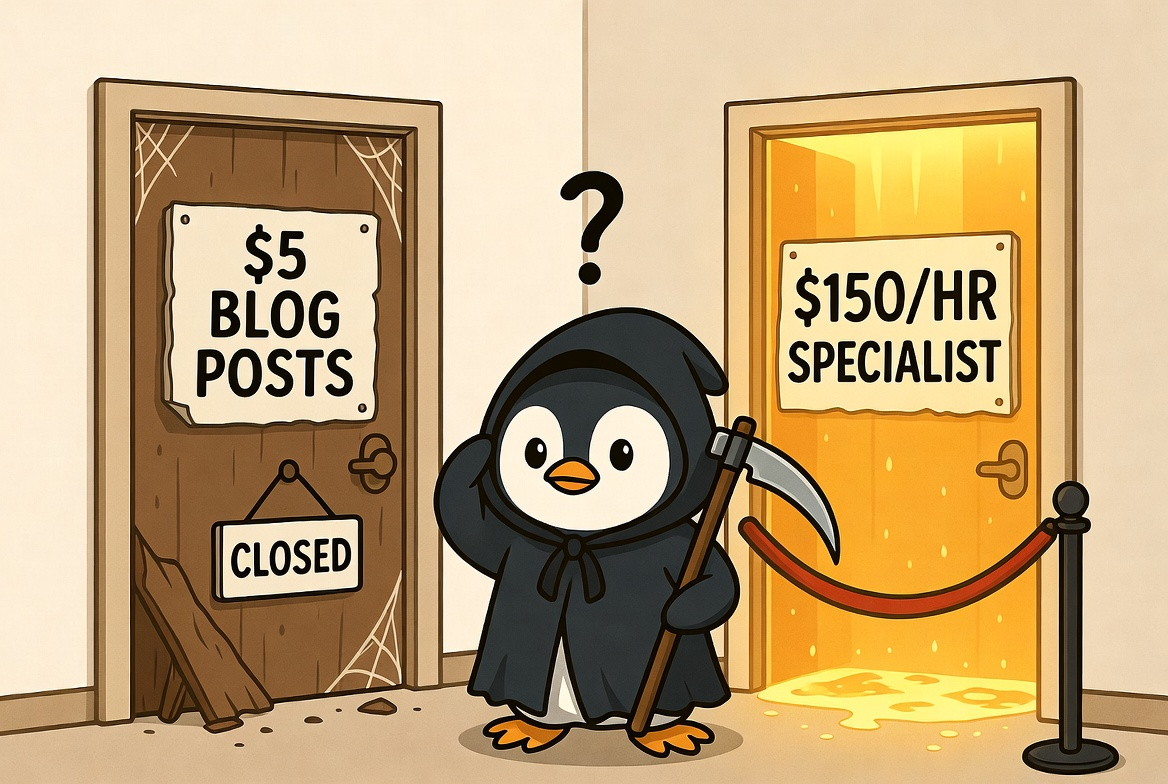
Is freelance writing dead? Short answer: no. Longer answer: half of it is, and the other half is making more money than ever.
That’s not a “motivational poster take.” It’s what the research from Imperial College London, Harvard, and a stack of 2025 and 2026 platform data actually shows. Freelance writing didn’t die in 2026. It split in two. The bottom, where writers sell words by the piece for anyone willing to pay, is in genuine trouble. The top, where writers bring expertise, consistency, and something AI can’t replicate, has never paid better.
If you’ve been stress-scrolling freelance subreddits at midnight wondering whether to pivot to plumbing, this article is the data dump you need before making any decisions. We’ll walk through what the numbers say, why the “just specialize” advice is incomplete, and the one habit that keeps showing up in every writer who landed on the right side of this split.
No doom. No cheerleading. Just data and a plan.
The Bottom Fell Out (and the Data Proves It)
Platform Data: What Upwork and Fiverr Numbers Show
The decline is not speculation. A study from Imperial College London, Harvard Business School, and the German Institute for Economic Research analyzed nearly two million freelance job postings across 61 countries between July 2021 and July 2023. Within eight months of ChatGPT’s launch, demand for freelance writing fell roughly 30%, the steepest drop of any category they studied.
That data window closed in mid-2023. Since then, the trend has accelerated. A separate Bloomberry analysis of over five million job listings found freelance writing postings down 33% since ChatGPT’s release, independently confirming the decline from a completely different dataset.
The most current platform data tells the same story at a steeper angle. Mediabistro’s analysis of the Vollna Upwork Market Report (covering 2.2 million projects) shows writing projects on Upwork declined 32% year over year in 2025. Eleven of twelve major work categories saw declines. Entry-level project availability dropped below 9%, down from 15% the prior year.
From the buyer side, Fiverr’s data shows a parallel story. The total number of active buyers declined. But spend per buyer rose 8.3% year over year. Fewer clients are buying writing. The ones who are still buying are spending more per project. That’s the first clue this isn’t a simple “everything is dying” story.
The Ramp Study: Where the Money Actually Went
The most revealing data comes from Ramp, the corporate card platform that tracks real business spending across thousands of companies. Their February 2026 “Payrolls to Prompts” study found that more than half of businesses spending on freelance platforms in 2022 had stopped entirely by 2025.
The spending share shift is stark. Freelance marketplace spending as a share of total company spend dropped from 0.66% to 0.14%. AI model spending at those same companies went from zero to 2.85%.
The cost math explains why. Ramp found that for every dollar reduced in freelance spending, the most AI-exposed firms spent only about three cents on AI tools. That’s roughly a 25x cost difference. When a company can get “good enough” blog posts for 3% of what they used to pay a writer, the commodity end of the market doesn’t stand a chance.
The Ceiling Got Higher
AI-Adjacent Writers Are Earning More
Here’s the part most “freelance writing is dead” articles bury three-quarters down the page: the writers who work with AI tools are pulling in significantly more than those who don’t.
Upwork reported that AI-related freelance work crossed $300 million in annualized value by late 2025. Freelancers on AI-related projects earned 44% more per hour than those on non-AI projects. Content writing still ranked among the top 10 most in-demand AI-related skills on the platform, making AI writing jobs one of the few growth areas in the freelance market.
Upwork’s In-Demand Skills report from February 2026 showed demand for AI freelance skills growing 109% year over year. That’s nearly five times the 23% growth rate for other in-demand skills.
Fewer Clients, Bigger Checks
The pattern across platforms tells a consistent story: fewer buyers, bigger projects, higher rates. Fiverr’s Q3 2025 data showed spend per buyer rising even as the total buyer count fell. Upwork’s gross services volume grew 2% overall, but 52% of that growth came from AI-related work.
The specialist premium is real and measurable. Mediabistro’s March 2026 reporting found medical writers charging $60 to $150 per hour, fintech writers earning up to $0.95 per word, and white paper specialists commanding $6,000 or more per month. Meanwhile, MBO Partners reported that 5.6 million independent workers earned $100,000+ in 2025, nearly double the 3 million who hit that mark in 2020.
There’s a reason for the rebound at the top. A University of Copenhagen study of 25,000 workers across 7,000 workplaces found that AI’s actual productivity impact was underwhelming for most businesses, with the majority seeing only about a 3% time savings. Companies that flooded their blogs with AI-generated content saw search rankings drop and quietly started hiring humans again. In an Upwork survey, 58% of businesses said they’d prioritize AI proficiency when hiring freelancers, but 39% said they still lacked trust in AI’s accuracy. That tension is the opportunity for writers who can do both: use the tools and bring the judgment.
The Freelancer Kompass 2026 report found that 84% of freelancers now regularly use AI-powered tools, up from 41% in 2023. AI proficiency isn’t a differentiator anymore. It’s baseline.
Why Top Performers Aren’t Safe Either
The Uncomfortable Finding From the Research
If you’re a skilled freelance writer thinking “this doesn’t apply to me,” the data has bad news. The Hui et al. study published in Organization Science found that high-quality freelancers, those with strong track records and higher rates, were not insulated from AI disruption. In some cases, they were disproportionately affected.
The INFORMS press release put it bluntly: generative AI isn’t just reducing opportunities for less-skilled workers. It’s cutting into the core of what has always made top performers successful. When AI can produce competent first drafts in seconds, “competent writing” stops being the thing clients pay a premium for.
Reputation Alone Doesn’t Protect You Anymore
This is the part that makes experienced freelancers uncomfortable. The old playbook, build a reputation, charge premium rates, rely on quality, doesn’t work the same way when the floor of “acceptable quality” has been raised by free tools.
I watched this happen from the agency side before AI was even part of the conversation. Clients who used to pay $500 for a blog post started getting pitches at $50 because the market flooded with writers willing to work for exposure. The good writers who survived weren’t the ones who were “better.” They were the ones who brought something the cheap writers couldn’t: expertise in a specific domain, relationships that took years to build, and a portfolio that proved they understood the reader better than any prompt could generate.
The Entry-Level Pipeline Problem
The Numbers for New Writers
If you’re trying to break into freelance writing in 2026, the numbers are sobering. Entry-level project availability on Upwork fell below 9%, down from 15% the prior year. The cheap gigs that used to serve as training wheels for new writers, “$25 for a 500-word blog post” types, are the exact gigs AI replaced first.
This creates what researchers call a pipeline problem. If entry-level gigs disappear, how do new writers build the experience and portfolio they need to compete for the higher-paying work that still exists? The path from “I want to write” to “I get paid to write” has a new gap in the middle.
What Breaking In Actually Looks Like Now
The writers breaking in successfully in 2026 aren’t starting on job boards. They’re starting by writing. Publishing on their own sites, building a visible portfolio, and developing expertise in a specific subject before they ever pitch a client.
This is where daily writing practice stops being self-improvement advice and starts being career strategy. A writer who has 50 published pieces on a personal blog about, say, renewable energy policy has something no job board application can replicate: visible proof that they know the subject, they can write about it consistently, and they show up.
If you’re starting from zero, the best first step isn’t applying to gigs. It’s building a body of work. Even five minutes a day on prompts for beginners builds muscle and evidence that you’re a writer who writes, not just someone who wants to.
What “Specialize” Actually Means (Not Just “Find a Niche”)
The Three Things Surviving Writers Share
Every article on this topic eventually says “specialize.” None of them tell you what that actually looks like. Based on the data, the writers thriving in the 2026 market share three things.
First, they have AI tool proficiency. Not “I tried ChatGPT once” proficiency. The Upwork data shows freelancers who work with AI tools earn roughly 40% more per hour. They use AI for research, outlining, and first-draft acceleration, alongside free writing tools that keep the habit going, then add the strategic thinking and subject-matter depth that AI can’t.
Second, they have domain expertise. Not “I can write about anything” generalism. Specific, demonstrable knowledge in a vertical: healthcare compliance, fintech regulation, B2B SaaS, renewable energy. Something that makes their writing informed by understanding, not just competent at sentences.
Third, they have visible portfolios. Published work that prospective clients can find. Not samples in a Google Drive folder. Actual pieces indexed by search engines, proving they write consistently about their subject.
What a Specialized Writer’s Week Looks Like
When I ran a content agency, the writers who consistently landed the best clients weren’t the ones refreshing Upwork all day. Their week looked something like: two days producing client deliverables, one day writing for their own site (building the portfolio and SEO presence), one day doing outreach or relationship maintenance, and one day learning something new in their niche. They treated freelancing like a business, not a series of one-off gigs. The ones who “just wrote” without building expertise or visibility were the first to feel market pressure.
The One Habit That Separates Both Sides
Why the Writers Who Made It Never Stopped Writing
Markets shift. Algorithms change. Entire categories of freelance work appear and disappear. The writers who are still standing after every cycle share one trait that has nothing to do with talent, networking, or AI tools: they kept writing.
Not “writing when inspired.” Not “writing when the clients are flowing.” Writing daily, including days when the market feels broken and nobody’s hiring and the subreddits are full of people saying freelance writing is dead. The habit itself becomes the competitive advantage. A writer who has written 500 words a day for six months has a portfolio, a rhythm, and a relationship with the craft that no market downturn can erase.
I’ve been writing 500 words a day for years. Not because I’m disciplined. Because after the first two weeks, it stopped being a decision and started being the thing I do before coffee. I’ve written through market crashes, client droughts, and entire industries pivoting underneath me. The writing was never the thing that changed. The writing was the thing that kept me employable while everything else changed.
Building When Nobody’s Watching
The best time to build a daily writing habit was before AI disrupted the future of freelance writing. The second best time is today. Not because it guarantees freelance success (nothing does), but because the writers who will be thriving in 2027 are the ones building right now, writing pieces that demonstrate their thinking, developing expertise that compounds, and treating quick writing exercises not as busywork but as reps.
You don’t have to be great at it. You don’t even have to be good at it. You just have to show up consistently enough that when opportunity arrives, you have a body of work to point to and say: “Here. This is what I can do.”
So, is freelance writing dead? The commodity floor collapsed. The specialized ceiling went up. The data is clear on both points. Where you land depends on whether you’re selling words by the piece or bringing something AI can’t generate: expertise, consistency, and a visible track record of showing up.
The writers who are thriving in 2026 share one trait: they write every day and they specialize. Not because they found some secret hack. Because daily writing builds the portfolio, the expertise, and the muscle memory that separates “I’m a writer” from “here’s 200 published pieces proving it.”
If the uncertainty around freelance writing is affecting you, that’s a completely reasonable response to a market shifting in real time. Talk to someone you trust if it’s weighing on you. Writing can be a great outlet, but it’s not a replacement for real support when you need it.
And if you’re ready to start building the habit? BadDrafts sends you one absurd prompt every day and tracks your streak. Start your first terrible draft at baddrafts.com. The bar is low. That’s the point.