
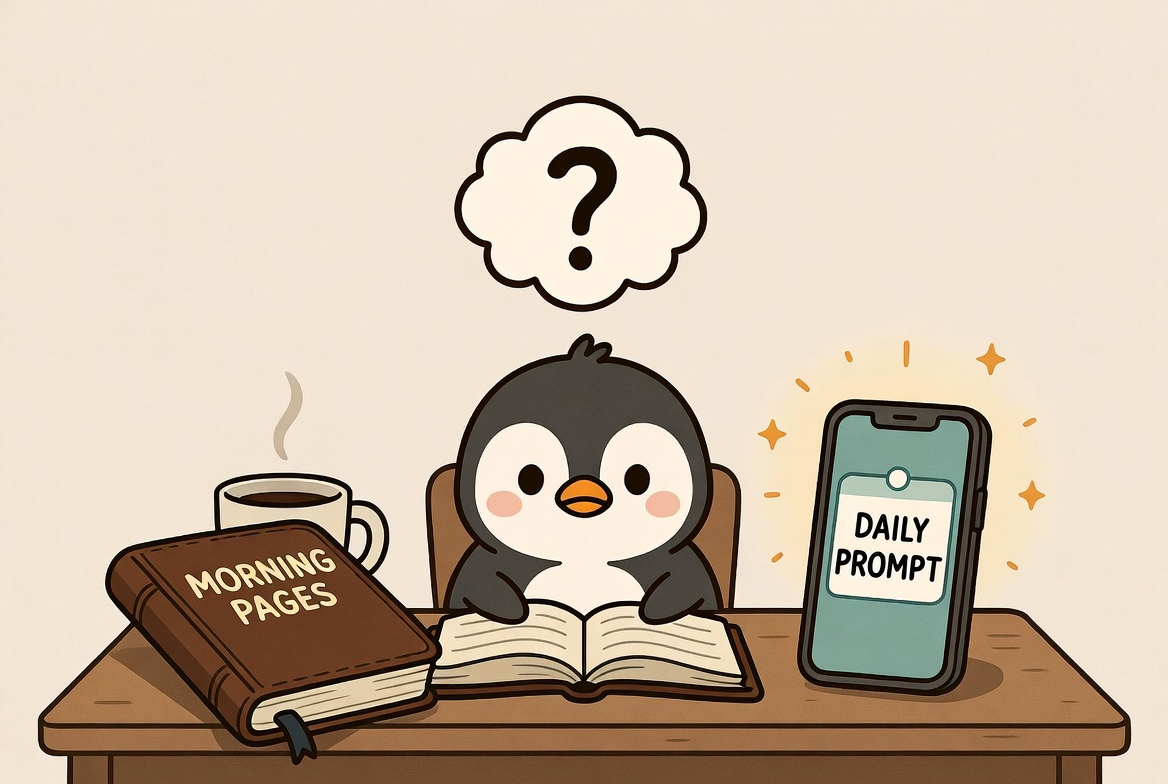
Morning pages have a loyal fanbase and a quieter graveyard of people who bought The Artist’s Way, made it 11 days, and decided they were the problem. They weren’t. The practice works beautifully for some writers and bounces off others for reasons that have nothing to do with discipline or seriousness. Daily writing prompts run on the opposite mechanic: one short, specific trigger, a focused response, 5 to 15 minutes of your actual life, and something you can usually keep.
The real question isn’t which practice is “better” in some universal sense. It’s which one matches the specific way your writing habit keeps dying on you.
Below is a head to head comparison: time, friction, what the research actually supports, the real case against each, and a decision framework that picks for you based on your blocker instead of whoever wrote the most viral post about it.
What Are Morning Pages, Really?
Morning pages are three pages of longhand stream-of-consciousness writing, done first thing in the morning, before anything else in your day. The practice was defined by Julia Cameron in The Artist’s Way, published in 1992, which packages morning pages as part of a 12-week creative recovery program. Cameron calls the pages “spiritual windshield wipers” and describes them as a form of meditation. They are not journaling, not planning, not gratitude lists, and not art.
The Three Rules Julia Cameron Laid Down
Cameron is strict about the format, and the rules are what separate morning pages from ordinary journaling. Three pages, not two. Longhand, not keyboard. First thing in the morning, before other input reaches your brain. You write whatever comes into your head, without editing, without stopping, until you fill the pages. Nobody reads them, including you, for at least the first eight weeks.
If you think “I have nothing to write,” you write “I have nothing to write” until the next thought arrives. The constraint is the point: the pages aren’t supposed to be good, and they aren’t supposed to be read.
What Cameron Was Actually Trying to Do
Morning pages weren’t designed as a productivity habit or a self-help tool. Cameron built them as a creative recovery practice for blocked artists, writers, and creative professionals who had buried their work under fear, criticism, and life noise.
The volume is what does the work: three pages takes long enough to drain the surface chatter of the mind and leave room for whatever’s underneath. The privacy rule exists so the inner critic has nothing to audition for.
What Counts as a Daily Writing Prompt?
A daily writing prompt is a short, specific trigger that hands you a starting point so your brain can skip the blank-page decision and go straight to responding. “Write an apology letter from your inner critic to your future self.” “Describe the most unhinged thing you thought about at 3 AM this week.” “Your brain has a complaint box. Empty it.”
A prompt gives you a constraint, a voice, or a scenario. You write for 5 to 15 minutes, usually 50 to 300 words, and end with something concrete on the page.
The Three Ingredients of a Good Prompt
A prompt that works is specific, surprising, and actually usable. “Write about a time you felt happy” is generic and fails all three. “Write a Yelp review for the sun” is specific (you’re writing a Yelp review, not a think piece), surprising (the sun isn’t a business), and usable (you can write it in five minutes and finish with a piece you’d show someone). Vague prompts are just blank pages with a slightly smaller border.
Why the Blank Page Problem Disappears
The blank page isn’t a creativity problem, it’s a decision problem. It asks you to pick a topic, pick a voice, pick an angle, pick a tone, and start writing, all in the same breath. A good prompt makes four of those five decisions for you. All that’s left is responding, and responding is dramatically easier than generating from nothing.
This is why well-designed daily prompts work for people who’ve never been able to stick with open journaling: the friction drops from “invent a reason to write” to “answer this question.”
The Head-to-Head: Time, Friction, Output, Fit
Here’s the side-by-side, with numbers where numbers exist:
| Factor | Morning Pages | Daily Prompts |
|---|---|---|
| Daily time | 30 to 45 minutes | 5 to 15 minutes |
| Starting friction | High (blank page, 3 full pages) | Low (trigger given, short response) |
| Output you can keep | None by design (don’t re-read for 8 weeks) | High (reusable drafts) |
| Research base | Anecdotal (expressive writing adjacent) | Anecdotal (expressive writing adjacent) |
| Format | Longhand required | Typed or handwritten |
Time Commitment
Morning pages take roughly 30 to 45 minutes a day at the average handwriting speed of about 20 words per minute. Three pages runs about 750 words. Daily prompts at 5 to 15 minutes land at one sixth to one half of that time. Over a month, the difference is roughly 15 hours versus 5 hours. Over a year, the difference is a part-time job.
Starting Friction
Cameron’s design makes morning pages frictional on purpose. The blank page, the three-page length, the longhand requirement, and the first-thing-in-the-morning rule all stack friction, because the friction is what forces mental emptying. Prompts strip friction out of the system. You don’t decide what to write about, you decide whether to respond. For people who’ve bounced off morning pages, the friction wasn’t a feature. It was the thing that killed the habit.
Output You Can Actually Keep
Cameron’s rule is that you don’t re-read morning pages for at least eight weeks, and many practitioners discard the pages entirely. That’s the point: the work isn’t the writing, it’s the act of writing. Prompts produce keepable output. A good prompt response is the first draft of an essay, a funny text, a scene in a story you’re building. You end the session with something concrete.
What the Research Actually Says
Morning pages specifically have not been rigorously studied. The closest research base is James Pennebaker’s expressive writing paradigm, which has been tested in more than 400 studies since 1986. Pennebaker’s protocol is 15 to 20 minutes of writing about difficult emotional experiences, repeated over 3 to 5 sessions, as summarized in a peer-reviewed Cambridge review.
Across more than 100 studies, the average effect size on health outcomes is roughly Cohen’s d of .16, which is small but statistically meaningful. Pennebaker’s specific protocol (short, focused, topic-directed) sits closer to a structured prompt than to three pages of stream of consciousness.
When Morning Pages Work Better
Morning pages earn their time commitment when your blocker is specifically mental noise or a deep creative blockage, and when you have the 30-plus minutes to spend. They’re a catharsis tool, not a production tool.
If Your Blocker Is Mental Noise or Perfectionism
If your brain wakes up every morning loud, looping, pre-populated with a to-do list, three unfinished arguments, and a vague sense of failure, morning pages were designed for exactly you. The volume is what drains the noise.
Three pages takes long enough that the surface chatter runs out somewhere around page two, and whatever’s underneath gets a chance to surface. The privacy rule is what silences the inner critic: the pages have no audience, so there’s nothing to perform for.
If You’re in a Creative Recovery Phase
If you’re a lapsed artist, a burned-out writer, or someone who used to make things and stopped, the 12-week Artist’s Way program (morning pages plus weekly “artist dates” plus guided exercises) is a genuine creative recovery framework. It was designed for people who had buried the work, and the 12 weeks matches the timeline of actually unburying it. Morning pages used outside this full program are a tool. Morning pages inside the full program are more like a rehab protocol.
I haven’t completed the full Artist’s Way program, so I can’t vouch for the creative recovery arc from the inside. What I can say: the creative professionals in my orbit who finished it describe the 12 weeks as actually doing something, not just vibes.
When Daily Prompts Work Better
Prompts win in the three scenarios where morning pages tend to collapse: the blank page is the blocker, the time isn’t there, or you want something to keep.
If Your Blocker Is the Blank Page Itself
For people who’ve bought five journals and filled zero, the blank page is the actual problem. It’s not motivation. It’s decision fatigue at 7 AM. A prompt eliminates four of the five decisions (topic, voice, angle, tone) and leaves only “respond.” The friction drop is enormous, and it’s the reason prompts for reluctant writers work for people who hate writing prompts in principle.
If You Have 15 Minutes, Not 45
Most people don’t have 45 uninterrupted morning minutes. They have a commute, a kid, a dog, a job that starts at 8:30, and a cup of coffee going cold. A daily practice that demands 45 minutes is a practice that won’t survive contact with Tuesday. Ten minutes at 7:12 AM is more habit than forty minutes you schedule for Saturday and skip. The shorter the daily practice, the more it compounds, which is why 30-second writing challenges work at all.
If You Want to Produce Something You Can Reuse
Morning pages are private by design, and most of the volume recycles into nothing. Prompts produce material. A response from today can become a blog post tomorrow, a scene next month, a freelance pitch next quarter. If “write every day” feels pointless without a result, prompts give the result.
For Pale Ale Travel, I’ve been writing at least 500 words a day for years, and the practice I actually sustained looks more like prompts than morning pages. Most sessions are triggered: a meal I ate, a neighborhood I walked through, a specific question about a place. Something outside my own head to point at. The few times I’ve tried the stream-of-consciousness version between trips, I’ve never made it past a week.
The Honest Case Against Morning Pages (That Nobody Tells You)
Morning pages have a near-religious fanbase, which means the critique gets drowned out. There are two real problems with the practice that get glossed over in most writeups.
The Rumination Trap
For people in active depression, anxiety, or recent trauma, unstructured stream-of-consciousness writing can deepen rumination instead of clearing it. Writer Jennifer Tatroe, in an essay about why she quit morning pages, describes her own mother filling thousands of pages with pain, doubt, anger, and hurt over a lifetime. Tatroe’s own experience: she’d start the session feeling fine and finish in tears. The research on expressive writing is inconsistent for exactly this reason.
Some meta-analyses find small benefits for depression, others find null effects. Stream of consciousness without structure can become a hamster wheel of the same fears, looped back to yourself at 6 AM every day. If that’s your pattern, structured prompts or no writing at all is the better call.
The Longhand Rule in a Typing World
Cameron insists on longhand, and the research actually supports her. A 2024 EEG study by Van der Weel and Van der Meer at NTNU found that handwriting activated broader brain network connectivity than typing. But Cameron wrote in 1992, and most people in 2026 type every word they produce except grocery lists.
If longhand is what makes morning pages work, most people doing “digital morning pages” on one of the many free writing apps are doing something different, not better or worse, just not the thing Cameron tested.
A Decision Framework (Pick Based on Your Blocker, Not the Vibes)
Here’s the decision table. Find the row that sounds most like you, match to the practice, try it for a week.
| Your specific blocker | Best-fit practice | Why |
|---|---|---|
| Perfectionism, loud inner critic | Morning pages | Volume plus privacy drowns the critic |
| Blank-page paralysis | Daily prompts | Starting point removed |
| Under 20 minutes a day available | Daily prompts | Fits real schedules |
| Active depression or rumination spiral | Structured prompts; talk to a clinician | Unstructured free-association can amplify the loop |
| Wanting reusable output | Daily prompts | Produces draftable material |
| Deep creative recovery phase | Morning pages (full 12-week Artist’s Way) | Designed for exactly this |
Try This Week (a 7-Day Mini-Experiment)
The framework is a starting point, not a verdict. The honest test is in your body, not the chart. Try this: three days of prompts (10 to 15 minutes each), three days of morning pages (three longhand pages each), one day of reflection. Write down which one you actually showed up for, which left you feeling lighter, and which produced something you’d want to see again. The winner is whichever one you’d still be doing on day 30, not the one with the prettier theory behind it.
Conclusion
Morning pages and daily prompts aren’t competing religions. They’re different tools for different failure modes. If your writing habit keeps dying because of mental noise and perfectionism, Cameron’s pages were built for you. If it keeps dying because the blank page is a wall, because 45 minutes don’t exist in your real life, or because you want to end each session with something you can keep, prompts fit better.
One honest note before the end: if you’re in an active depression, anxiety spiral, or processing recent trauma, unstructured morning pages can sometimes deepen rumination rather than clear it. If that sounds like where you are, talk to a clinician or therapist before committing to any daily writing practice, and lean toward structured prompts if you try writing at all.
If the prompt approach fits you better, BadDrafts is a daily writing app built on exactly that mechanic. One specific, absurd prompt lands in your inbox every morning. You write a bad draft. Tomorrow, another one shows up. Write daily. Write badly.